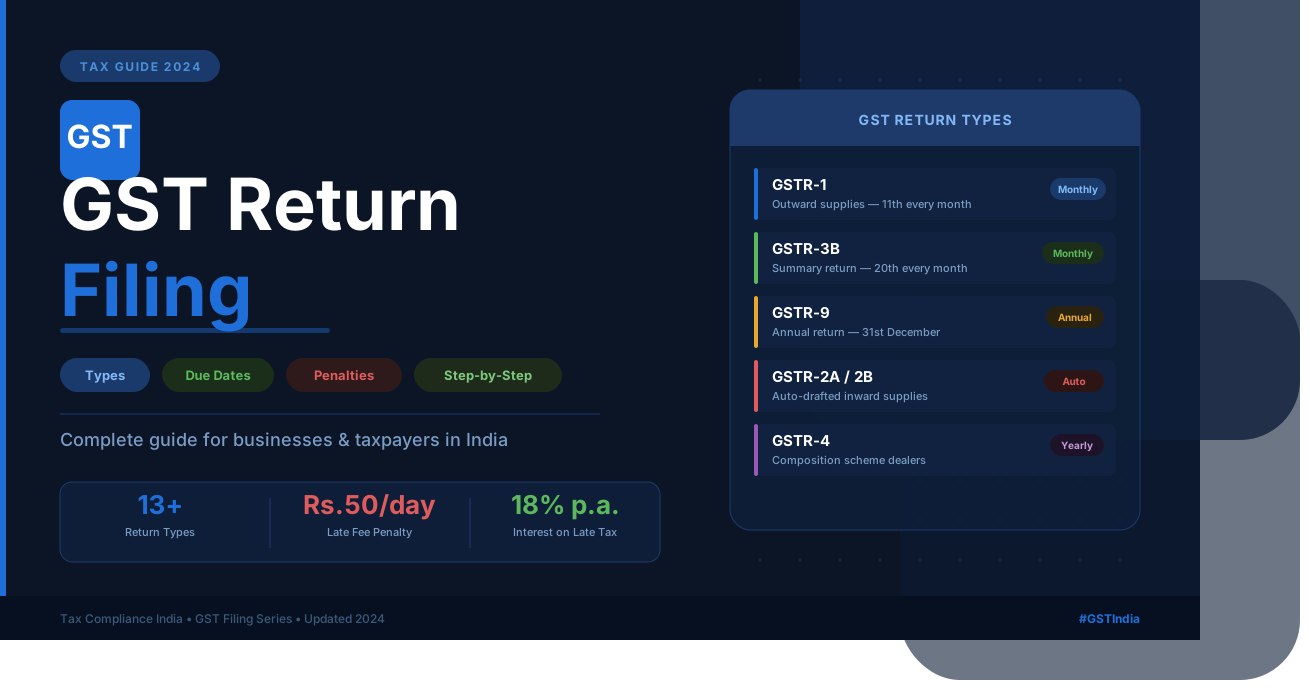
Introduction
If you’re running a business, GST return filing is something you simply can’t ignore. With different types of returns, fixed due dates, and late fees if you miss them, it’s easy to slip up and that can cost you.
Find the right expert, without the hassle.
Connect with verified professionals for tax, legal, and compliance needs.
The good news is, once you understand how it all works, it’s actually quite manageable. Whether you’re a business owner, a professional, or handling compliance for clients, having clarity on GST returns can save you both time and unnecessary stress.
In this guide, we’ll break down the types of GST returns, their due dates for 2026, penalties to watch out for, and a simple step-by-step way to file them correctly.
Who Should File GST Returns?
Every business or individual registered under GST
Businesses whose turnover exceeds the prescribed threshold limit
Individuals or entities who have taken voluntary GST registration
Composition scheme dealers (under a simplified scheme)
Input Service Distributors (ISD)
Non-resident taxable persons supplying goods or services in India
E-commerce operators and aggregators
Casual taxable persons making occasional taxable supplies
Note: Even if there is no transaction in a period, a nil GST return must be filed to stay compliant and avoid penalties.
Types of GST Returns and Due Dates
Return Type | Applicability | Frequency | Due Date |
GSTR-1 | Regular taxpayers (outward supplies) | Monthly / Quarterly (QRMP) | 11th of next month / 13th of month following quarter |
GSTR-3B | Regular taxpayers (summary return) | Monthly / Quarterly (QRMP) | 20th of next month (monthly) / 22nd or 24th of month following quarter |
GSTR-4 | Composition scheme taxpayers | Annually | 30th April following financial year |
CMP-08 | Composition taxpayers (tax payment) | Quarterly | 18th of month following quarter |
GSTR-5/GSTR-5A | Non-resident taxable persons and OIDAR service provider | Monthly | 13th(GSTR-5) / 20th(GSTR-5A) of next month |
GSTR-6 | Input Service Distributors (ISD) | Monthly | 13th of next month |
GSTR-7 | TDS deductors under GST | Monthly | 10th of next month |
GSTR-8 | E-commerce operators (TCS) | Monthly | 10th of next month |
GSTR-9 | Annual return (regular taxpayers) | Annually | 31st December following financial year |
GSTR-9C | Reconciliation statement (applicable taxpayers) for Turnover above Rs. 5 crore | Annually | 31st December following financial year |
GSTR-10 | Final return upon surrender of GST registration | One time | Within 3 months from the date of cancellation or date of cancellation order, whichever is later |
GST Returns Due Dates
GSTR-1 (Details of Outward Supplies)
Quarterly (QRMP)
Period | Due Date (FY 2026–27) |
Apr – Jun 2026 | 13th July 2026 |
Jul – Sep 2026 | 13th Oct 2026 |
Oct – Dec 2026 | 13th Jan 2027 |
Jan – Mar 2027 | 13th Apr 2027 |
Monthly (Turnover above ₹5 Cr)
Period | Due Date (FY 2026–27) |
Apr 2026 | 11th May 2026 |
May 2026 | 11th Jun 2026 |
Jun 2026 | 11th Jul 2026 |
Jul 2026 | 11th Aug 2026 |
Aug 2026 | 11th Sep 2026 |
Sep 2026 | 11th Oct 2026 |
Oct 2026 | 11th Nov 2026 |
Nov 2026 | 11th Dec 2026 |
Dec 2026 | 11th Jan 2027 |
Jan 2027 | 11th Feb 2027 |
Feb 2027 | 11th Mar 2027 |
Mar 2027 | 11th Apr 2027 |
GSTR-3B (Summary Return)
Quarterly (QRMP)
Period | Due Date (FY 2026–27) |
Apr – Jun 2026 | 22nd / 24th July 2026 |
Jul – Sep 2026 | 22nd / 24th Oct 2026 |
Oct – Dec 2026 | 22nd / 24th Jan 2027 |
Jan – Mar 2027 | 22nd / 24th Apr 2027 |
Monthly
Period | Due Date (FY 2026–27) |
Apr 2026 | 20th May 2026 |
May 2026 | 20th Jun 2026 |
Jun 2026 | 20th Jul 2026 |
Jul 2026 | 20th Aug 2026 |
Aug 2026 | 20th Sep 2026 |
Sep 2026 | 20th Oct 2026 |
Oct 2026 | 20th Nov 2026 |
Nov 2026 | 20th Dec 2026 |
Dec 2026 | 20th Jan 2027 |
Jan 2027 | 20th Feb 2027 |
Feb 2027 | 20th Mar 2027 |
Mar 2027 | 20th Apr 2027 |
CMP-08 (Composition Scheme Payment)
Period | Due Date (FY 2026–27) |
Apr – Jun 2026 | 18th Jul 2026 |
Jul – Sep 2026 | 18th Oct 2026 |
Oct – Dec 2026 | 18th Jan 2027 |
Jan – Mar 2027 | 18th Apr 2027 |
GSTR-4 (Composition Annual Return)
Period | Due Date |
FY 2026–27 | 30th June 2027 |
GSTR-5 (Non-Resident Taxable Person)
Period | Due Date |
Monthly | 20th of next month |
GSTR-5A (OIDAR Services)
Period | Due Date |
Monthly | 20th of next month |
GSTR-6 (Input Service Distributor - ISD)
Period | Due Date |
Monthly | 13th of next month |
GSTR-7 (TDS under GST)
Period | Due Date |
Monthly | 10th of next month |
GSTR-8 (TCS by E-commerce Operators)
Period | Due Date |
Monthly | 10th of next month |
Annual Returns
Return | Due Date |
GSTR-9 | 31st December 2027 |
GSTR-9C | 31st December 2027 |
Notes:
QRMP Scheme applicable for turnover up to ₹5 crore
GSTR-3B (QRMP) due date depends on state category (22nd / 24th)
Dates mentioned are standard statutory due dates
Always verify for latest GST notifications or extensions
Interest on Late Payment of GST
Particulars | Interest Rate |
Late payment of GST liability | 18% per annum |
Excess ITC claimed / wrong ITC utilized | 24% per annum |
GST Late Fees & Penalties for Non-Filing / Delay (FY 2026–27)
Return Type | Late Fee (Per Day) | Maximum Late Fee | Notes |
GSTR-1 | ₹50 per day (₹25 CGST + ₹25 SGST) ₹20 per day (Nil return) | ₹5,000 | Applies for delay in outward supply return |
GSTR-3B | ₹50 per day ₹20 per day (Nil return) | ₹5,000 | Most common return; late fee auto-calculated |
GSTR-4 (Composition Annual) | ₹50 per day ₹20 per day (Nil return) | ₹2,000 | Annual return for composition dealers |
GSTR-5 / 5A | ₹50 per day | ₹5,000 | For non-resident & OIDAR taxpayers |
GSTR-6 (ISD) | ₹50 per day | ₹5,000 | Input Service Distributor return |
GSTR-7 (TDS) | ₹50 per day | ₹2,000 | Delay in TDS return filing |
GSTR-8 (TCS) | ₹50 per day | ₹5,000 | Applicable to e-commerce operators |
GSTR-9 (Annual Return) | ₹200 per day (₹100 CGST + ₹100 SGST) | 0.25% of turnover in State/UT | No late fee for NIL in some cases (subject to notification) |
GSTR-9C | ₹25,000 penalty (general penalty) | ₹25,000 | No fixed late fee, but penalty may apply |
CMP-08 | No late fee | — | Interest applies on delay |
Other Returns | ₹50 per day | ₹5,000 | General rule if not specified |
Frequently Asked Questions (FAQs) on GST Return Filing
1. What is GST return filing?
GST return filing is the process of reporting details of sales, purchases, tax liability, and input tax credit to the GST authorities.
2. Who is required to file GST returns?
All businesses and individuals registered under GST, including composition dealers, e-commerce operators, and non-resident taxable persons, must file GST returns.
3. What happens if no transactions are made in a period?
Even if there are no transactions, a nil GST return must be filed to remain compliant and avoid penalties.
4. What are the main types of GST returns?
The key GST returns include GSTR-1, GSTR-3B, GSTR-4, CMP-08, GSTR-5, GSTR-6, GSTR-7, GSTR-8, GSTR-9, and GSTR-9C.
5. What are the due dates for GST returns?
GST return due dates vary by return type. For example, GSTR-1 is due on the 11th or 13th, and GSTR-3B is due on the 20th, 22nd, or 24th of the following month.
6. What is the QRMP scheme in GST?
The QRMP scheme allows taxpayers with turnover up to ₹5 crore to file returns quarterly while making tax payments monthly.
7. What are the late fees for delayed GST return filing?
Late fees generally start from ₹50 per day (₹20 for nil returns) and vary depending on the type of return, subject to maximum limits.
8. What is the interest rate on late payment of GST?
Interest is charged at 18% per annum on delayed tax payment and 24% per annum on excess or wrongly claimed ITC.
9. What is GSTR-3B?
GSTR-3B is a summary return that includes details of tax liability and input tax credit and must be filed monthly or quarterly.
10. What is GSTR-9 and GSTR-9C?
GSTR-9 is the annual return for regular taxpayers, while GSTR-9C is a reconciliation statement applicable for specified taxpayers.
11. What is CMP-08?
CMP-08 is a quarterly statement used by composition scheme taxpayers to pay their tax liability.
12. What are the penalties for non-filing of GST returns?
Non-filing or delayed filing can lead to late fees, interest, and penalties, depending on the type of return and delay period.


