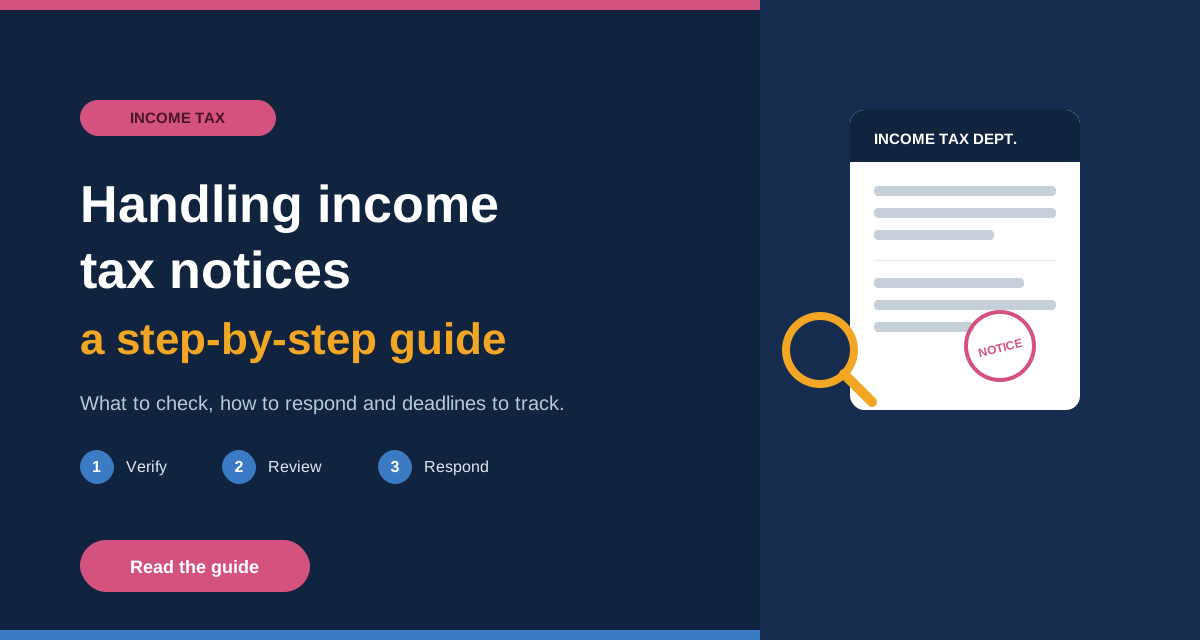
Handling income tax notices has now become a regular part of a Chartered Accountant’s work. With the Income Tax Department keeping a closer watch, notices related to mismatches, defective returns, and pending tax dues have become quite common.
Find the right expert, without the hassle.
Connect with verified professionals for tax, legal, and compliance needs.
Because of this, many professionals and taxpayers often look up things like “how to manage income tax notice” or “income tax notice reply procedure” to understand what needs to be done.
In this blog, we’ve broken down a simple, step-by-step approach that CAs can follow to deal with income tax notices in a practical and smooth manner.
Understanding Income Tax Notices
An income tax notice is basically a communication from the Income Tax Department asking for clarification or pointing out something that doesn’t match in a taxpayer’s return. It doesn’t always mean something is wrong , it could simply be a request for more information or verification.
In practice, notices are usually triggered due to a few common reasons, such as:
Difference between reported income and department records
High-value transactions showing up in AIS or Form 26AS
Return not filed or filed incorrectly
Mismatch in TDS or TCS details
Case selected for scrutiny
For a Chartered Accountant, the first and most important step is to clearly understand what kind of notice has been issued, because the response approach depends entirely on that.
Step 1: Identify the Type of Notice (As per Income Tax Act, 2025)
The first thing you should always check is under which provision the notice has been issued. While many notices still refer to familiar section numbers, CAs need to be mindful that under the Income Tax Act, 2025, the structure and section mapping may be different—even though the intent remains largely similar.
In 2026, taxpayers may come across the following commonly issued income tax notices:
Defective Return:
A Section 139(9) notice is issued when your income tax return has some error or missing information. In simple terms, the Income Tax Department is asking you to correct your return. This could happen due to incomplete details, incorrect figures, or mismatches in income or TDS. You are usually given a specific time to fix the issue and re-submit the return. If you don’t respond within the deadline, your return may be treated as invalid, meaning it will be considered as not filed at all.
Scrutiny Notice
A Section 143(2) notice is issued when the Income Tax Department wants to closely check your return in detail. In simple terms, it means your case has been selected for scrutiny to verify whether the income, deductions, and claims you reported are correct. You may be asked to provide documents like bank statements, bills, or proofs of investments. It’s important to respond properly and on time, as this notice involves a deeper review of your return.
Reassessment Notice
Section 148 notice is issued when the Assessing Officer believes that certain income has escaped assessment. It allows the department to reopen past assessments within prescribed time limits.
Handling such notices requires careful review of past records and a legally sound response
Income Mismatch Notice (AIS/TIS Based)
This type of notice is issued when the income shown in your return does not match the details available in your AIS (Annual Information Statement) or TIS (Taxpayer Information Summary). In simple terms, the Income Tax Department is saying “we have information about your income which you haven’t reported correctly.” This can happen due to missed interest income, stock transactions, or high-value purchases. You should carefully compare your return with AIS/TIS data and either correct the mistake or provide a proper explanation with supporting documents.
Demand Notice
A demand notice is issued when the Income Tax Department believes that some tax is still unpaid after processing your return. In simple terms, it means “you need to pay additional tax.” This usually happens due to mismatches in TDS, incorrect tax calculation, or disallowed deductions. You should carefully check the details mentioned in the notice—if it is correct, pay the amount within the given time. If not, you can respond online with proper explanation and supporting documents.
Step 2: Verify the Notice Details
Before you jump into drafting a reply, take a step back and quickly check the basics. It sounds simple, but it saves a lot of unnecessary stress later.
Just confirm:
PAN and name of the taxpayer
Assessment year mentioned in the notice
Whether the notice is actually available on the income tax e-filing portal
In many cases, clients tend to panic and forward whatever they receive without checking it properly. A quick verification helps you stay calm, avoid confusion, and make sure you’re dealing with a genuine income tax notice.
Step 3: Understand the Issue Properly
Now comes the part where your professional judgement really matters.
Go through the notice carefully and try to understand:
What exactly is being questioned
Whether it’s a data mismatch or compliance issue
What documents or explanation may be required
Instead of rushing into a reply, take time to analyse the situation. A well-understood issue is already half resolved.
Step 4: Collect Relevant Documents
Once the issue is clear, start gathering all supporting documents. This usually includes:
Filed income tax return and computation
Bank statements
Form 16 / Form 16A
Form 26AS, AIS, TIS
Investment proofs or invoices
In many cases, the strength of your response depends more on documentation than explanation. So it’s worth spending time here.
Step 5: Draft a Clear and Practical Response
While replying, keep things simple and to the point.
A good response should:
Directly address the issue raised
Be supported with proper documents
Avoid unnecessary technical language unless required
In faceless assessments especially, your written reply is the only way to present your case. So clarity matters more than complexity.
Step 6: Submit Within the Deadline
One of the most common mistakes is missing the due date. Even a strong response loses value if it’s delayed.
Make sure you:
Check the deadline mentioned in the notice
Submit the response through the e-filing portal
Request adjournment in advance if more time is needed
Timely compliance helps avoid penalties and unnecessary escalation.
Step 7: Keep Track and Follow Up
After submission, don’t just assume the matter is closed.
Regularly check the status on the portal
Be prepared for follow-up queries
Keep all communication properly documented
A proactive approach here ensures that the case doesn’t drag unnecessarily.
Common Mistakes to Avoid
Even experienced professionals sometimes overlook basic things. Watch out for:
Ignoring notices or delaying response
Submitting incomplete information
Over-explaining instead of being precise
Not reviewing documents properly before submission
Avoiding these can save a lot of time, effort, and potential penalties.
Key Changes under the New Income Tax Act, 2025 (Impact on Notices)
With the introduction of the Income Tax Act, 2025, the way tax notices work has changed quite a bit. The system is now more digital, more data-driven, and less dependent on manual processes. For CAs and taxpayers, this mainly means being more careful upfront rather than fixing things later.
1. Everything is now online
Notices, replies, submissions—almost everything happens through the portal now. There’s hardly any physical interaction, so whatever you submit in writing becomes your main representation.
2. Notices are triggered by data, not guesswork
The department is using data from AIS, TIS, bank accounts, and investments to track mismatches. Even small differences can get picked up, so accuracy while filing has become really important.
3. PAN is connected across systems
Since PAN is linked with multiple financial databases, transactions are easy to track. This makes it difficult to miss reporting income, even unintentionally.
4. Faster processing, quicker outcomes
Because of automation, notices are issued faster—and responses are also processed quickly. While this may increase the number of notices, it also means cases get closed faster if everything is in order.
5. Less focus on section numbers
With the new structure, section numbers may feel unfamiliar. In practice, it’s easier to focus on what the notice is asking for—whether it’s a correction, explanation, or verification—rather than the section itself.
6. New formats and system-based filing
There’s more reliance on pre-filled data and updated forms. So, reviewing and reconciling information before filing has become a necessary step, not an option.
Practical takeaway:
The approach has clearly shifted—earlier, issues could be managed later, but now it’s better to get things right at the time of filing itself. Clean records and proper matching with AIS/TIS can save a lot of trouble later.
Conclusion
Handling income tax notices today is less about firefighting and more about staying prepared. With the shift to a more data-driven system under the Income Tax Act, 2025, even small errors can lead to notices, so getting things right at the time of filing has become really important.
For Chartered Accountants, a clear and timely response, backed by proper documents, usually makes the process much smoother. In the end, good preparation not only helps in resolving notices efficiently but also builds confidence and trust with clients.