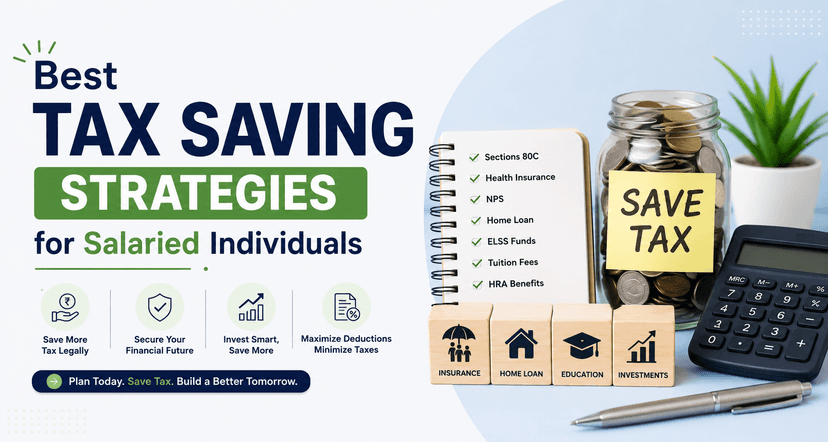
Most salaried individuals in India spend a huge portion of their income towards taxes every financial year.However, with proper tax saving strategies for salaried individuals, it is possible to reduce this burden legally by making smarter financial decisions.
There are several smart ways to save tax without complex financial planning such as deductions under Section 80C, benefits like HRA, 80D, and NPS etc.
Find the right expert, without the hassle.
Connect with verified professionals for tax, legal, and compliance needs.
In this guide, we’ll explore practical and easy-to-understand tax saving tips for salaried employees in India that can help you lower your taxable income and make better use of available exemptions.
Understanding Income Tax for Salaried Individuals in India
Before planning tax savings, it is important to understand how salary income is taxed. In India, income tax is calculated based on slabs defined by the government, and different deductions can help reduce your taxable income.
A salaried individual can reduce tax liability using:
Exemptions (like HRA, standard deduction)
Deductions (like 80C, 80D, 80E)
Investments (like PPF, ELSS, NPS)
1. Maximize Deductions Under Section 80C
Section 80C is the most widely used tax-saving option for salaried employees. You can claim deductions up to ₹1.5 lakh per year.
Common 80C investment options:
Public Provident Fund (PPF)
Employees Provident Fund (EPF)
Equity Linked Saving Scheme (ELSS)
Life Insurance Premium
Principal repayment of home loan
Example: If you invest ₹1.5 lakh in ELSS or PPF, your taxable income reduces by the same amount.
2. Claim Health Insurance Benefits Under Section 80D
Medical insurance not only protects your health but also helps in tax saving.
Deductions available:
Up to ₹25,000 for self and family
Additional ₹50,000 for senior citizen parents
Example: Paying health insurance premium can directly reduce your taxable income while ensuring financial protection.
3. Use HRA (House Rent Allowance) Exemption Smartly
If you live in a rented house, you can claim HRA exemption as part of your salary structure.
HRA exemption depends on:
Actual rent paid
Salary structure
City of residence
Tip: Always keep rent receipts and rental agreement ready for claims.
4. Benefit from Standard Deduction
The standard deduction is a fixed deduction available only to salaried individuals and pensioners, which reduces taxable income automatically.
₹75,000 under New Tax Regime
₹50,000 under Old Tax Regime
This deduction reduces your taxable salary directly without any investment or proof.
5. Invest in NPS for Additional Tax Benefit
The National Pension System (NPS) is a smart way to save tax while planning for retirement.
Benefits:
Additional ₹50,000 deduction under Section 80CCD(1B)
Long-term wealth creation
Tax-efficient investment option
6. Claim Deduction on Education Loan (Section 80E)
Interest paid on education loans is fully deductible.
No upper limit
Available for up to 8 years
Ideal for young salaried professionals.
7.Leave Travel Allowance (LTA)
Leave Travel Allowance allows you to claim tax exemption on travel expenses incurred during leave within India.
Covers travel expenses (air, rail, bus) for you and your family
Can be claimed for 2 journeys in a block of 4 years
Only travel cost is exempt (not hotel or food expenses)
Example: If you travel with your family and spend ₹30,000 on airfare, this amount can be claimed as tax-free under LTA (subject to conditions).
8. Food Coupons / Meal Allowance
Many employers provide meal benefits through coupons or prepaid cards, which are partially tax-exempt.
Benefits:
Up to ₹50 per meal is tax-free
Can significantly reduce taxable income over time
No investment required
Example: Monthly meal benefits can reduce your taxable income by a noticeable amount annually.
9. Mobile and Internet Reimbursements
If your job requires phone or internet usage, these expenses can be reimbursed by your employer and are usually tax-free.
Key points:
Must be used for official purposes
Bills or proof may be required
Fully exempt if within company policy
This is a simple way to convert a regular expense into a tax-saving component.
10. Conveyance and Travel Reimbursements
Expenses incurred for official travel can be reimbursed and are generally not taxable.
Includes:
Fuel expenses
Cab or travel costs for work
Office-related commuting (as per company policy)
Instead of receiving a higher taxable salary, structured reimbursements help reduce tax liability.
Latest Tax Rules for FY 2025-26 (Important Updates)
New tax regime continues as default
Standard deduction increased to ₹75,000 under new regime
Most deductions not allowed under new regime
Taxpayers can switch regimes based on benefits
Choosing the right regime is crucial for effective tax planning.
Common Tax Saving Mistakes to Avoid
Waiting until the last month to invest
Not comparing old vs new tax regime
Ignoring long-term financial goals
Investing only for tax saving, not returns
Missing out on deductions due to lack of planning
Practical Tips for Better Tax Planning
Start planning at the beginning of the financial year
Align tax saving with investment goals
Keep proper documentation
Review your tax regime annually
Conclusion
The best tax saving strategies for salaried individuals in India go beyond just reducing tax—they focus on building a disciplined financial approach. While the old tax regime offers multiple deductions for those who invest, the new regime provides simplicity with lower tax rates and a higher standard deduction.
The key is to evaluate both options carefully and choose the one that maximizes your savings. Start early, plan wisely, and make tax saving a part of your overall financial strategy rather than a last-minute activity.