Introduction
Find the right expert, without the hassle.
Connect with verified professionals for tax, legal, and compliance needs.
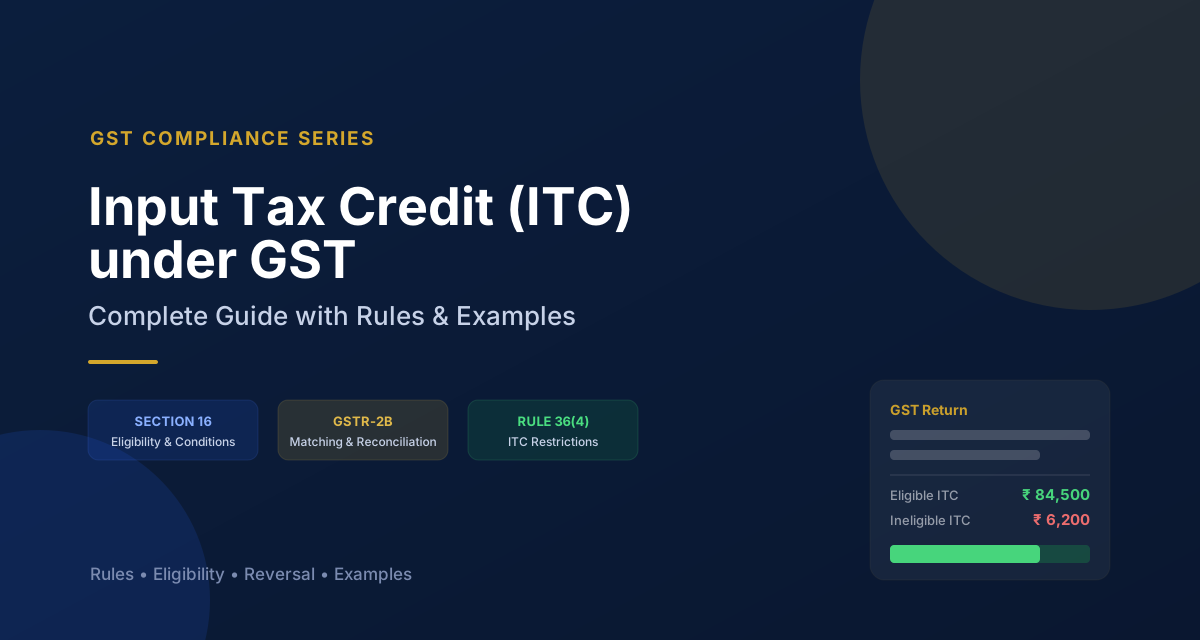
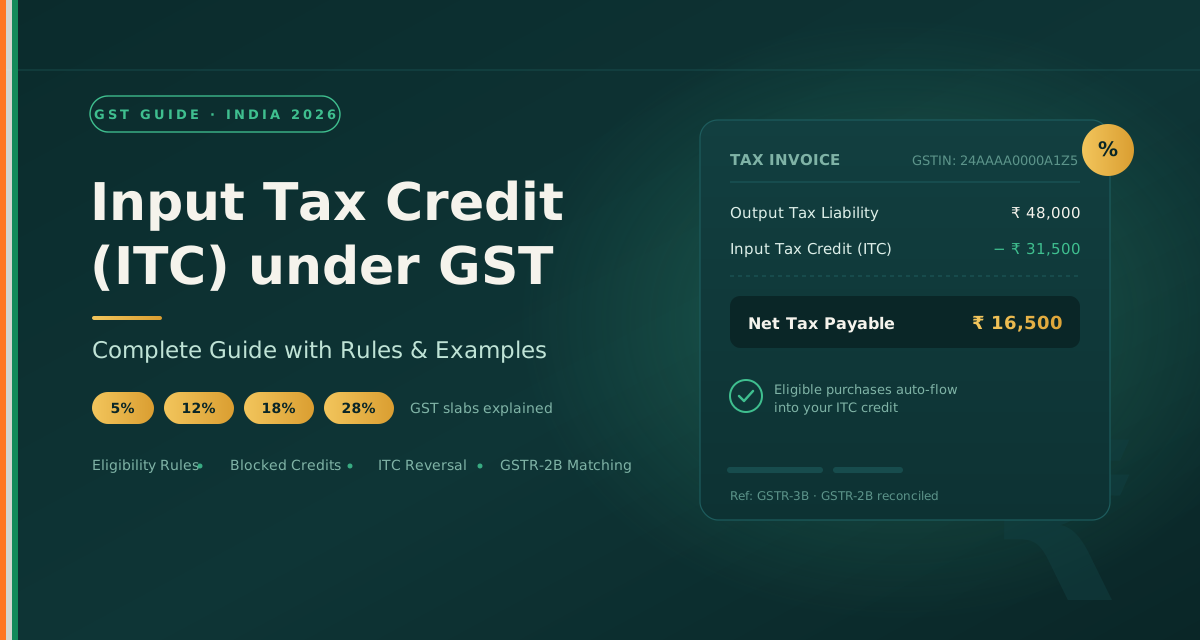
Input Tax Credit (ITC) under GST helps businesses lower their tax burden by claiming credit for the GST paid on purchases. While it sounds simple ,it is very important to understand the eligibility rules, conditions, and blocked credits.
In practice, many businesses face issues like ITC mismatch in GSTR-2B and ITC rejection, often due to small errors or lack of clarity. That’s why understanding how to claim ITC under GST and the eligibility criteria is essential.
In this blog, we’ll break down ITC in a simple and practical way, covering the key rules, common issues, and how to ensure smooth compliance.
What is Input Tax Credit (ITC)?
Input Tax Credit (ITC) under GST means you can reduce your tax liability by claiming credit for the GST you’ve already paid on purchases (inputs, input services, or capital goods).
In simple terms, you don’t pay tax on the full value—only on the value you add.
Example:
Suppose Webledger, a cloud accounting software company:
Particulars | Amount (₹) | GST (18%) (₹) | Total (₹) | ITC Available |
Purchase: Cloud Hosting Services | 80,000 | 14,400 | 94,400 | Yes |
Sales: Software Subscription | 2,00,000 | 36,000 | 2,36,000 | Not Applicable |
GST Calculation:
Particulars | Amount (₹) |
Output GST (on sales) | 36,000 |
Less: ITC (on purchases) | 14,400 |
Net GST Payable | 21,600 |
Summary:
Webledger uses the GST paid on expenses (₹14,400) to reduce its total tax liability and finally pays only ₹21,600 to the government
Time Limit to Claim Input Tax Credit (ITC) under GST
Under GST law, ITC must be claimed within a specified time limit to ensure compliance.
ITC can be claimed up to 30th November of the following financial year, or
Before filing the annual return (GSTR-9), whichever is earlier.
Who Can Claim Input Tax Credit (ITC) under GST?
A clear understanding of who can claim ITC under GST is essential to ensure compliance and avoid rejection of credit. Below are the key conditions:
Only a person registered under GST can claim Input Tax Credit. Unregistered persons are not eligible to avail ITC.
The taxpayer must have a valid tax invoice, debit note, or prescribed document issued by a registered supplier.
ITC can be claimed only when the goods or services have actually been received. In case of goods received in installments, ITC is allowed only after full receipt.
The supplier must have deposited the GST with the government. If the supplier fails to do so, ITC may be denied.
The taxpayer must have filed the required GST returns, especially GSTR-3B, to claim ITC.
The invoice should be reflected in GSTR-2B, ensuring proper matching and reducing the risk of ITC mismatch.
ITC is allowed only for business-related use. Personal expenses are not eligible for credit.
ITC must be claimed within the prescribed time limit (generally up to 30th November of the following financial year or filing of annual return, whichever is earlier).
Blocked Credits under GST
Under GST, certain expenses are specifically restricted from claiming Input Tax Credit (ITC), even if they are used for business purposes. These are known as blocked credits under GST.
Expense Type | ITC Status | When ITC is Allowed (Exceptions) | Practical Insight (What to Watch) |
Motor Vehicles | Not Allowed | Allowed for transport of goods, passengers, or training | Common mistake: ITC claimed on company cars for directors |
Food & Beverages | Not Allowed | Allowed if statutorily required or for outward supply | Staff meals usually not eligible unless legally mandated |
Club / Gym Membership | Not Allowed | No major exceptions | Personal in nature , generally always disallowed |
Employee Welfare Expenses | Not Allowed | Allowed if required under law | Voluntary benefits often lead to ITC disallowance |
Works Contract (Construction) | Not Allowed | Allowed only for plant & machinery | Office construction ITC is a common area of dispute |
Construction of Property | Not Allowed | Allowed for plant & machinery | Even business-use buildings , ITC not available |
Personal Expenses | Not Allowed | No exceptions | Clear separation of personal vs business is essential |
Lost / Stolen Goods | Not Allowed | No exceptions | ITC reversal required, affects cash flow |
Gifts / Free Samples | Not Allowed | No exceptions | Often missed in marketing ,may trigger notices |
Documents Required for Claiming Input Tax Credit (ITC) under GST
To claim Input Tax Credit (ITC) under GST, having the right documents in place is crucial. Even a small missing detail can lead to ITC rejection or delays, so proper record-keeping becomes very important.
A proper GST invoice from a registered supplier with all required details.
Debit note is needed if the tax amount or value is increased
Bill of entry is required for claiming ITC on import of goods
Invoice or credit note issued by the Input Service Distributor (ISD)
A bill of supply issued by a supplier of goods and services or both
Reversal of Input Tax Credit (ITC) under GST
Input Tax Credit (ITC) reversal under GST refers to the situation where a taxpayer has to pay back the ITC already claimed due to non-fulfilment of conditions prescribed under GST law.
ITC must be reversed if payment to supplier is not made within 180 days from invoice date
It is required when goods or services are used for both taxable and exempt supplies (partial reversal)
ITC has to be reversed on blocked credits under Section 17(5) if claimed incorrectly
Reversal is also applicable when goods are lost, stolen, destroyed, or given as free samples/gifts
ITC reversal directly increases tax liability, so proper tracking of invoices, payments, and usage is essential for accurate GST compliance.
Practical ITC Compliance Checklist under GST
To claim Input Tax Credit (ITC) smoothly under GST, it’s important to follow a simple but consistent compliance process. Most ITC issues happen due to small gaps in checking or reconciliation.
Every month, match your purchase records with GSTR-2B to ensure ITC is correctly available
Check invoices properly for GSTIN, tax amount, and supplier details before booking ITC
Keep track of suppliers to ensure they are filing GST returns and paying tax on time
Review purchases regularly to avoid claiming blocked or ineligible ITC
Maintain proper records and documentation to support ITC during audits or scrutiny
A regular compliance routine helps avoid ITC mismatch, reversals, and unnecessary tax loss, while ensuring better GST control and accuracy.
Conclusion
Input Tax Credit (ITC) under GST is a simple concept, but in practice it needs proper care and regular checking. Small issues like GSTR-2B mismatch, blocked credits, or missing documents can easily lead to loss of ITC.
Most of these problems can be avoided with basic discipline in reconciliation and timely review of records.
In short, if books and GST returns are properly matched and checked regularly, ITC can be claimed smoothly without unnecessary errors or loss.